

Skip to content
ihl-2026-hero-desktop

IHL Order Management 2026 -
What Sets OMS Solutions Apart?

For the fifth consecutive year, Kbrw has been featured in the 2026 IHL Enterprise Order Management Market Study, alongside 17 other OMS providers evaluated on technology, operational capabilities, and innovation.
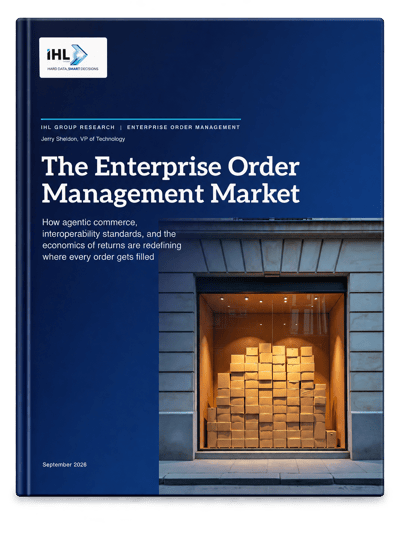
Mock-up of the IHL report on a transparent background

Discover IHL’s latest market analyses and the features that are redefining intelligent order orchestration. The “Enterprise Order Management Market 2026” report covers market trends, vendor comparisons, the maturity level of AI, and enterprise priorities when selecting an order management system (OMS).

In a nutshell

icon-smart-steering-chart-line-up-svg A $6.94 billion market
by 2030
Projected annual growth of 16.3%, driven by the adoption of SaaS and cloud computing.  
icon-flexibility-sliders-svg Decision quality over feature quantity

The quality of decisions takes precedence over the quantity of characteristics

 
head-circuit AI is moving from
vision to reality

Preparation for production deployment, governance, and measurable results are priorities.

 
icon-returns-reverse-logistics-swap-svg B2B—A Major Differentiator

Allocation, inventory sharing, and multi-party orchestration are features specific to businesses.


Overview of the IHL OMS 2026 Market Research Study

An independent evaluation of 18 OMS solution providers, examining market development, company capabilities, AI maturity, and vendor differentiation.

$6.94bn
market size by 2030
95%
Cloud & SaaS by 2030
9/18
offering AI agents in production
16.3%
Projected Annual Growth Rate

Four Trends That Are Redefining Order Management in Businesses

How Kbrw Stands Out

Enterprise-level execution. Complex orchestration. Explainable intelligence.

Kbrw combines optimized order management, advanced B2B capabilities, and transparent decision-making to help companies manage complex, decentralized supply chains.

TOUCH
stack Large-Scale Scalability
Large-Scale Scalability Proven performance in handling high volumes: more than 815,000 orders per minute recorded during a load test—ten times more than leading competitors
TOUCH
tree structure Advanced B2B and B2C Orchestration
Advanced B2B and B2C Orchestration

Complex distribution, protected inventory, and fulfillment involving multiple participants in the extended supply chain.

TOUCH
eye Explainable Enforcement Decisions
Explainable Enforcement Decisions

Transparent sourcing process, traceability of decisions, and simulation of alternative strategies.

TOUCH
polygon Embedded Integration Platform
Embedded Integration Platform

Event-driven integration, APIs, and configurable workflows that enable the connection of enterprise systems.

TOUCH
icon-future-proof-infinity-svg End-to-End Reverse Logistics
End-to-End Reverse Logistics

Coordinated returns and circular flows, with traceability covering all physical and financial processes.

TOUCH
check-square (1) A Governed Architecture Ready for Agent-Based Systems
A Governed Architecture Ready for Agent-Based Systems

AI-assisted investigation, controlled agent access, and transparent execution.

FAQ - Enterprise Order Management Market in 2026

What does IHL's 2026 market research report on enterprise order management cover? An independent market study evaluating 18 order management system (OMS) vendors in terms of order orchestration, technology, artificial intelligence capabilities, and market positioning.An independent market study evaluating 18 order management system (OMS) vendors in terms of order orchestration, technology, artificial intelligence capabilities, and market positioning.
What are the main trends in OMS for 2026?

Intelligent order management, decision explainability, simulation, out-of-the-box AI, agent interoperability, and complex B2B orchestration.

What sets enterprise OMS solutions apart?

Advanced procurement capabilities, in-depth expertise in the B2B sector, reliable delivery commitments, transparent decision-making processes, proven maturity in artificial intelligence, and operational scalability.

How does Kbrw differ from other OMSs? Through enterprise-wide implementation, advanced orchestration of B2B and B2C activities, transparent procurement decisions, and integration across various supply chain systems.
How does AI facilitate modern order management?

AI can facilitate anomaly analysis, predictive analytics, procurement recommendations, and certain regulated actions. Actual availability and autonomy vary by vendor.